Monday, July 22, 2013

Roots Hanging On

This time of year is usually the most hectic time for superintendents that are growing bentgrass in the south. We are 40 days away from September and we are 57 days away from our fall aerification. The fall aerification is the big date for the greens. This is when we can open them up with our big holes and allow them to breathe a little better. That is also when we start to grow our roots back and get our greens healthy. During the heat of the summer and the rainfall that usually accompanies the heat in Georgia, our roots shrink until they are almost nonexistent. Luckily this year, that hasn't been the case so far.  We have seen the roots lose some mass and also lose some length, but pulling samples today, they are still holding a sample together at an average of about 3.5"-4". This is very promising. In past years at this time, we haven't been able to hold a sample together below 1" or so.  We credit this to cooler temps mostly, but also to our Curfew application in the spring. We do not have the nematodes feeding on the roots as we have had in years past and this has helped tremendously. We also have to credit our soil penetrant that has helped us keep our greens as dry as possible in this extremely wet summer.  Without these three factors, there's no telling what our greens would look like right now.  There won't be a single golfer who will see what our roots look like, but every one of them notice the greens are healthy. Without healthy roots, the grass wouldn't be healthy.

This is the sample that the roots are holding together.  The first thing we look at when pulling a profile is how much the roots can hold together.  This is extremely good for July 22. (Notice the clean sand near the top from our past aerifications.)

The other thing we look at is the actual roots. The white color of these roots tells us that they are still relatively healthy. The presence of root hairs is also very promising because that is the part of the root that takes up the nutrients and water. 

Friday, July 19, 2013

Checking Green Speeds

For the last month, we have been checking and recording green speeds. We have 3 greens that we check daily so we are staying consistent. 
We have a USGA Stimpmeter that we check them with. It is a 3' long piece of aluminum that is v shaped with a groove near the top for the golf ball to rest in. You place a ball in the groove while holding the Stimpmeter low with one end on the green. You slowly raise the end with the ball until the ball starts to roll. Once you roll 3 balls, you measure the distance from the ball to the end of the Stimpmeter. Then you roll the balls back in the other direction. Once you measure the distance back, you take an average of the two distances and this is the green speed. Today they are rolling 9'5". 

Please Fill Your Divots

There is nothing worse than striping a perfect drive right down the middle of a perfectly manicured, lush green fairway just to have your ball wind up in a divot that no one bothered to fill with sand. 
Here is a picture taken this morning.  I watched a golfer hit his shot into 14 green. When he missed the green, he promptly dropped 5 more balls and tried again. He hit the green 3 times out of those 5 shots. He then got in his cart (which had a full sand bottle) and drove off. He got to the green and putted the closest ball without fixing any of his 3 ball marks. 
It took me about 15 seconds to fill and smooth his divots and about 30 seconds to fix his ball marks along with 3 or 4 more. Please take the time to do this and the course will be a lot better for it. 

Wednesday, July 17, 2013

Spraying Bermuda Runners


Today we sprayed all of the runners in our bunkers. We did not use a Glyphosate product such as Round-Up. The problem with using Glyphosate (active ingredient in Round-Up) products is that they move through the plant. If we sprayed that on our runners, it would have moved through the plant and we would see dead grass all around the bunkers instead of just where we sprayed the runners. We opted to use a product called Finale. It is a non selective herbicide like glyphosate, but it doesn't move through the plant. Once the runners die, we will pull them and touch up the edges of the bunkers. 
I'm sure any home owner who has sprayed weeds in their pinestraw or mulch has noticed the kill around the edges if they use Round-Up. Finale is a good option to use in these cases around the edges. 

Thursday, July 4, 2013

Repairing Ball Marks


Please repair your ball marks.  Everyone sees these signs around every course.  Not everyone knows how to repair their ball marks correctly. This time of year it is crucial for everyone to chip in and do their part to help the greens be the healthiest they can be.  This includes repairing the ball marks.  I have enlisted the help of Drew, our assistant pro, to help inform you how to correctly repair your ball marks.


Also, here is a link you can click on to better inform you on how and why to repair your ball marks correctly.  


Just remember to fix your ball mark and one other and the greens will be better for it.  

Tuesday, July 2, 2013

Venting


One cultural practice we perform during the summer months is venting our greens. Venting is opening the greens up so the roots can get some air. It also allows gas exchange in the soil and also lets the greens dry in wet conditions. For our venting, we use our aerifier with 1/4" solid tines.
Depending on weather and greens health, we will either load it up with 60 tines, or just go with a half load of 30. Today we loaded it up with 60. 
Our process today was a busy one. We started before daylight venting the greens and then immediately rolled them. We wanted to finish this part of the process before the heat of the day. 

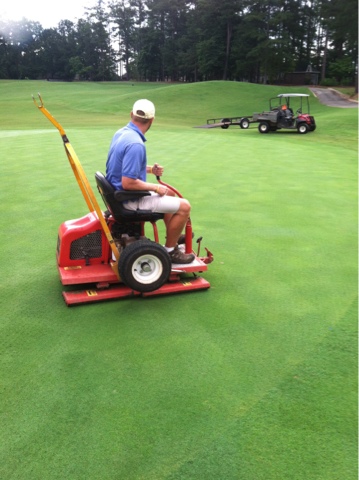
Then we came in and topdressed them.  Since the weather was cool and the greens are healthy, we decide to drag in our sand. We usually don't do this in the summer because it can be very abrasive to the greens, but it was cool and cloudy for most of the morning so we decided to drag. This helps to work the sand down into the canopy faster so we won't pick up the sand tomorrow with our mowers. 
This is the green after the venting. 
This is the holes after the roller. 
This is our finished product after the greens have been sanded and the sand was worked in using the drag. 
It looks like the holes are closed up, but they are still open under the surface allowing the roots to get some air and allowing gas exchange. This was a very important practice to do with all of the rain forecasted this week. 

Thursday, June 27, 2013

Dusting Greens


We have continued to lightly topdress, or dust, greens. This is another tool we use to keep our greens healthy. The benefits range from fighting algae to reducing temperatures. The light dusting also helps keep the greens rolling smooth and will actually speed the greens up about .5' on the stimpmeter the day of dusting. 
This is what the green looks like right after the dusting. As the day goes on, the sand starts to work its way into the canopy and is less visible. It is still benefiting the greens, but it is just less visible. 

Friday, June 21, 2013

Growth Regulators

Some of you have asked how the grass never got out of control over the last two weeks with all of the rain. The reason is a Plant Growth Regulator (PGR) we spray on our tees, collars, approaches, and fairways called Primo Maxx. This is another one of our tools we use for better turf. This chemical makes the plant put all of its energy into growing horizontally instead of vertically. It pretty much shuts down the vertical growth of the grass allowing it to really tighten up and fill divots faster. We spray it every 14-21 days depending on weather. With this product applied, we can afford to only mow our short cut bermudagrass once a week and will not have to worry about scalping or getting bombarded with an enormous amount of clippings. Without the PGR, we would have to mow at least twice a week and in some cases, three times. Along with the PGR we also add a humic acid product called Propel which acts as a liquid aerification to the soil. This is a new product for us this year and we are extremely happy with the results so far. 
So next time we get a lot of rain, just know we have chemicals working for us so our short cut bermudagrass will not get out of control. We can't guarantee the same for the rough, so I suggest you hit it straight. See you out here soon.